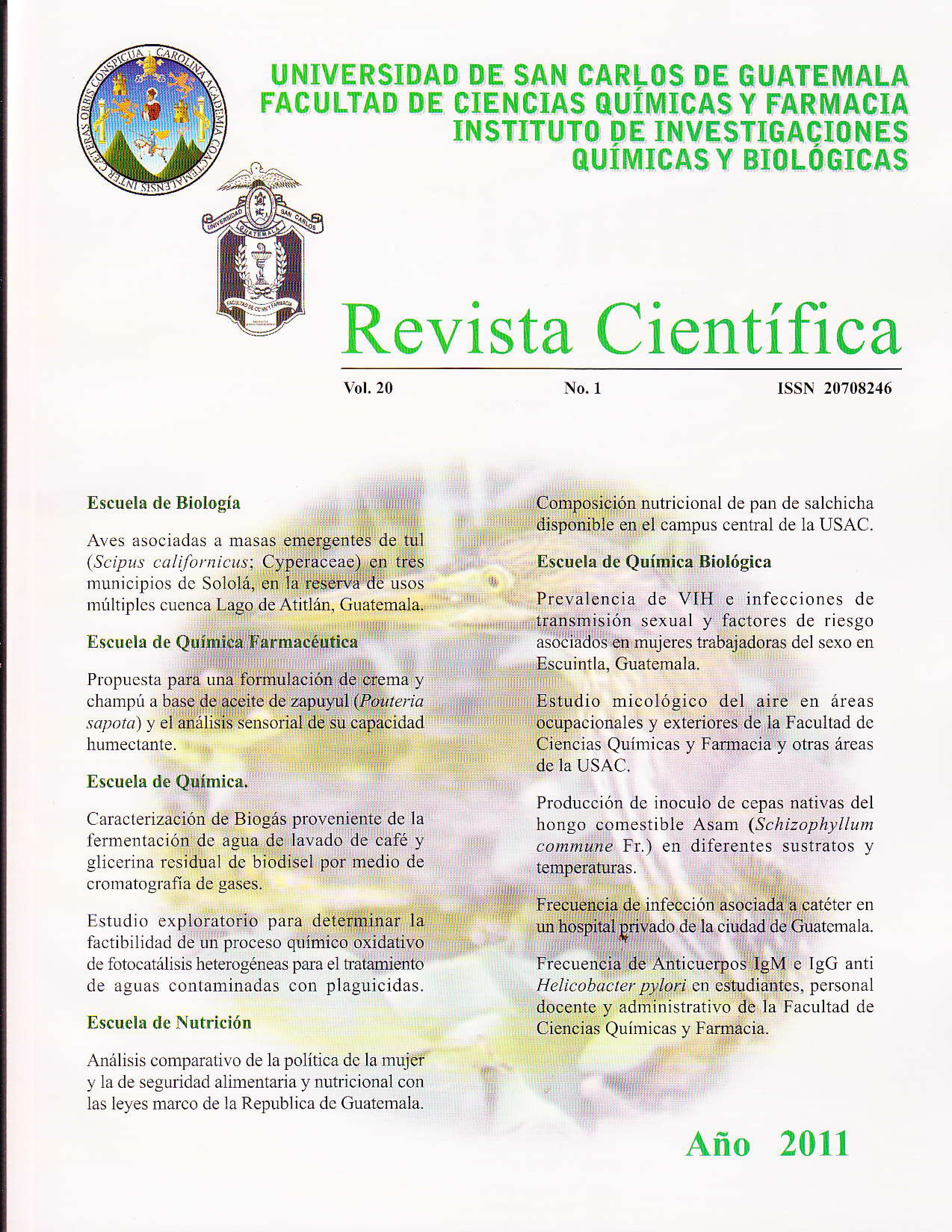
Frequency of catheter-associated infection in a private hospital in Guatemala City
DOI:
https://doi.org/10.54495/Rev.Cientifica.v20i1.149Keywords:
hospital, frequency, factors, catheter, infectionAbstract
This is a prospective study that was conducted over a period of one year ( 1 1/05 to 1 1/06) in a private hospital in Guatemala City. We determined the frequency and possible risk factors for infections associated with central venous catheters, and infectious agents commonly involved with their antibiotic susceptibility patterns. To do this, we followed up all patients that were placed with central venous catheters, through a data sheet and grown all the tips that were sent to the laboratory for medical decisions, Supplemented Maki thioglycol late broth was used for the culture technique. We withdrew a total of 122 catheters from 85 patients, however, only 87 catheters were used for the study, they were divided into four groups according to the number of catheters used in each patient; 57 corresponded to the first catheter that was placed in each patient, so they were analyzed separately. There weren't a second catheter analysis forward because there were few samples. We calcuíated the frequencies and associations, using ECXEL. Wc determined the value of chi square, p EPIDAT and using the frequency and patterns of bacterial susceptibility WHONET program. No statistically significant association was found between the results of culture oí the catheter with age, sex, duration of catheterization, catheter number of keys, use of other invasive way, suffering from systemic disease and use of systemic antimicrobial therapy (all p> 0.05). There was a significant association between the site of catheter placement and the culture result, with increasing frequency in the right jugular position, ( 4 of 4). The most frequent organism that isolated from catheters was Staphylococcus epidermidis (24%) and the percentage of bacteremia was 1.14%. We conclude that the percentage of colonization obtained in the study was relatively low compared with previous studies (8, 9, 11) in Guatemala, however, is considered to be high (20.69%) for the present study, compared with international standards. No significant relationship was found between duration of catheterization and infection, probably because the number of cases studied (p = 0.71 55).
Downloads
References
Alvarez, S. (1992).Infección asociada al uso de catéter venoso central en el departamento de medicina interna del Hospital Roosevelt. Tesis para optar al título de Médico y Cirujano, Facultad de medicina, Universidad Francisco Marroquin, Guatemala, Guatemala,
Del Valle, G. (1990). Incidencia de la infección nosocomial en la unidad de intensivo de adultos del Hospital General San Juan de Dios. Tesis para optar al título de Médico y Cirujano, Facultad de Medicina, Universidad Francisco Marroquin, Guatemala, Guatemala.
Dubón, D. (1989). Riesgo de infección asociada a catéter venoso central en la unidad de cuidados intensivos del Hospital General San Juan de Dios. Guatemala. Tesis para optar al título de Químico Biólogo, Escuela de Química Biológica, Universidad de San Carlos de Guatemala, Guatemala, Guatemala.
García, P. Paya, E. Olivares, R. Gotera, A. Rodríguez, J. Sanz, M. (2003). Diagnóstico de las infecciones asociadas a catéteres vasculares centrales, Consenso. Revista Chilena, infectología, 20. (1) 41-50. https://doi.org/10.4067/S0716-10182003000100006
Grigaites, A. (2000). Uso de catéteres venosos centrales (CVC) en oncología, Revista de oncología de Argentina, pp 1-11.
Juracán, E. (1990). Infección nosocomial en la unidad de terapia intensiva de adultos del Hospital Roosevelt, Tesis para optar a] título d e Medico y Cirujano, Universidad de San Carlos de Guatemala, Guatemala, Guatemala,
Kehr. J. Castillo, E . Laofourcade, M . (2002), Complicaciones infecciosas asociadas a catéter venoso central. Revista Chilena d e cirugía, 54(3), 216-224, Recuperado de http://www.cirujanosdechile.el/Revista/PDF%20Cirujanos%202002_03/Cir.3_2002%20Complica.Infecciosas.pdf.
Maki , D. Weise, C. Sarafin, H. (1977). A semicuantitativc culture method for identyfing intravenous catheter related infection. New England. (Version electronic). Journal Medicine 2.96, 1305-1309. Recuperado de http://ukpmc.ac.uk/abstract/MED/323710/reload=0;jsessionid-07705D30CEF471FFAE2E54614CA446C5.jvm4.
Ojeda. E. Mejia. G. Infecciones asociadas a catéteres. Consultado el 20 de agosto de (2005), Recuperado http://www.uninct.edu/cin2000/conferences/ojeda/ojeda.html.
Paniagua, R. (1992). Patogénesis de la infección asociada a catéter venoso central en la unidad de cuidados intensivos del Hospital General San Juan de Dios”. Tesis para optar al título de Químico Biólogo, Escuela de Química Biológica, Universidad de San Carlos de Guatemala, Guatemala, Guatemala.
Ramos, L. Galván, R. Martin. M, Mora, M. (2003). Incidencias de las complicaciones infecciosas en la cateterización intravascular. Revista Medicina intensiva, 27 (4), 24-8. Recuperado de http://www.elsevirer.es/sites/default/fi1es/elsevier/pdf/64/64v27n04aI3046228pdf001.pdf
Rodríguez C. (1982). infecciones nosocomiales en un Hospital Privado de la ciudad de Guatemala. Tesis para optar al título de Químico Biólogo, Escuela de Química Biológica, Universidad de San Carlos de Guatemala, Guatemala, Guatemala.
Úriz, J. Salvador. B. Gutiérrez, A. Petit, A, Anguiano. P. Sampcriz, A. (2005). Vigilancia y Control de las Bacteremias asociadas a dispositivos intravascularcs Consultado el 21 de agosto de 2005. Recuperado http://cfnavarra.es/salud/anales/textos/vol23/suple2/suple14a.html.
Downloads
Published
Issue
Section
License
Copyright (c) 2022 L. Pérez, M. Gil, C. Ramírez

This work is licensed under a Creative Commons Attribution 4.0 International License.
Authors who publish with this journal agree to the following terms:
- Authors retain copyright and grant the journal right of first publication with the work simultaneously licensed under a Creative Commons Attribution License 4.0 that allows others to share the work with an acknowledgement of the work's authorship and initial publication in this journal.
- Authors are able to enter into separate, additional contractual arrangements for the non-exclusive distribution of the journal's published version of the work (e.g., post it to an institutional repository or publish it in a book), with an acknowledgement of its initial publication in this journal.
- Authors are permitted and encouraged to post their work online (e.g., in institutional repositories or on their website) prior to and during the submission process, as it can lead to productive exchanges, as well as earlier and greater citation of published work.
How to Cite